Human Resource Restoration Management: A Framework for Organizational Continuity, Learning, and Evolution
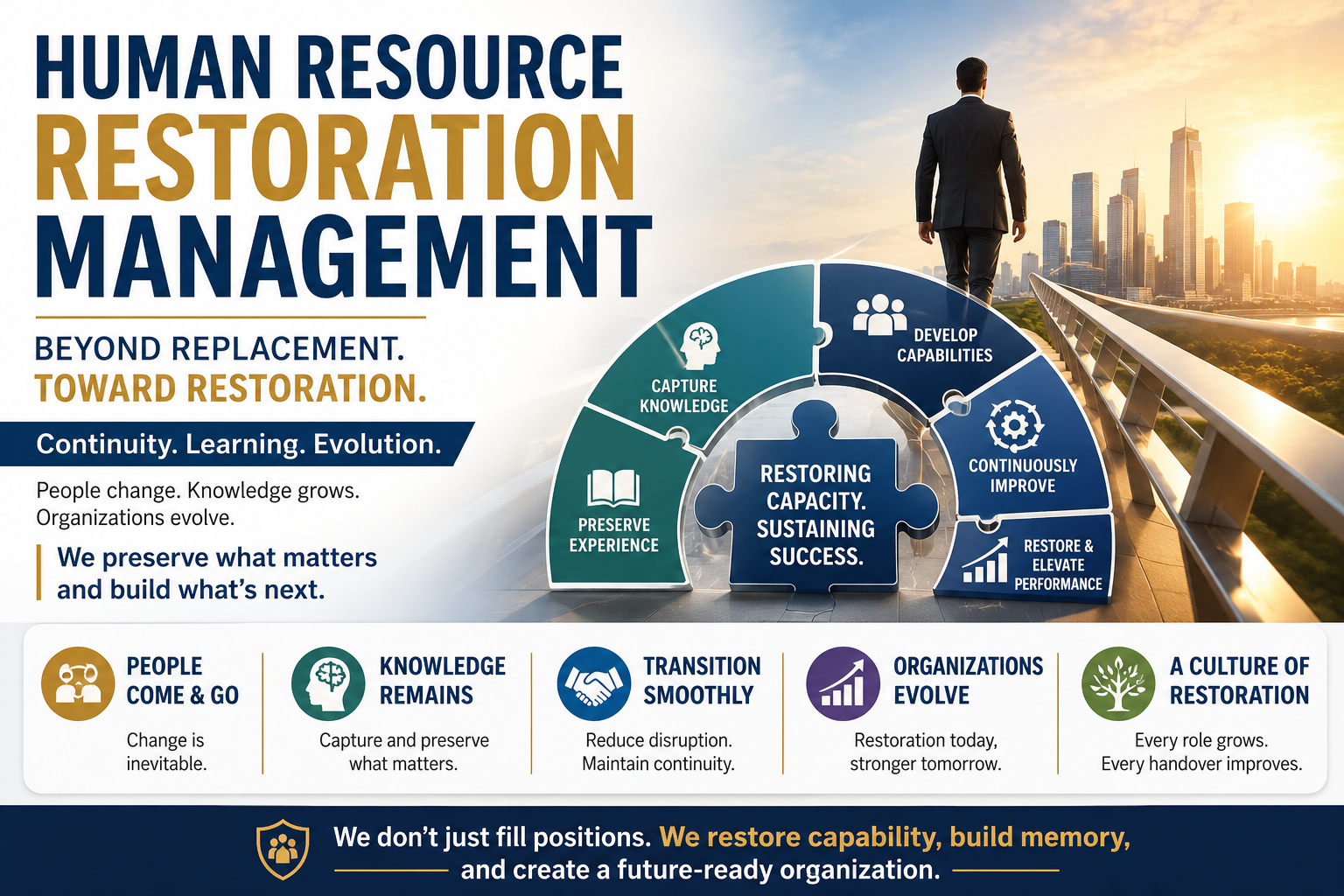
Human Resource Restoration Management: A Framework for Organizational Continuity, Learning, and Evolution
Introduction
No organization, regardless of its size, industry, or level of success, is immune to changes in its workforce. Retirement, resignation, migration, promotion, internal transfer, illness, career change, and many other factors continuously reshape an organization’s human resources.
Workforce attrition, therefore, should not be viewed merely as an unexpected event or occasional crisis. It is a natural and inevitable part of organizational life.
Yet many organizations begin thinking about replacement, knowledge transfer, or rebuilding lost capacity only after an employee has already left—and often after a significant portion of that employee’s knowledge and operational experience has become inaccessible.
Human Resource Restoration Management (HRRM) begins precisely at this point and asks a different question:
How can an organization be designed and managed so that changes in, or the departure of, its people cause the least possible disruption to organizational continuity and performance?
From Employee Retention to Organizational Capacity Preservation
Over the decades, Human Resource Management has developed valuable specialized disciplines, including recruitment, learning and development, performance management, employee retention, workforce planning, talent management, and succession planning.
HRRM neither replaces these disciplines nor diminishes their importance.
The difference lies in its ultimate objective.
In Human Resource Restoration Management, the challenge is not simply to find another person to fill a vacant position. The objective is to preserve and restore organizational capacity following inevitable workforce attrition.
HRRM therefore brings together existing HR disciplines around this common objective.
Human Resource Restoration Management can consequently be defined as a strategic management framework that enables an organization to anticipate unavoidable workforce attrition, preserve organizational capacity, and systematically restore operational performance through the timely reconstruction of human resources, organizational knowledge, and critical competencies.
In this approach, preparedness before attrition occurs becomes more important than reaction after it has occurred.
Why the Organizational Position Matters
One of the most important distinctions of HRRM is that it shifts the primary unit of analysis from the individual employee to the organizational position.
People enter organizations, acquire experience, develop professionally, and eventually leave for different reasons. The organizational position, however, continues to exist for as long as its underlying purpose remains relevant to the organization.
Restoration planning should therefore not begin merely with the question:
“Who currently holds this job?”
A more fundamental question is:
How can the continuity and capability of this position be maintained regardless of who occupies it?
This shift in perspective does not reduce the importance of employees. People remain the organization’s most important source of knowledge, judgment, creativity, and capability. However, the organization cannot make its continuity dependent upon the permanent presence of particular individuals.
Statements such as “Only he knew how to do this,” “All the information was with her,” or “Nobody can replace him” may demonstrate the value of an experienced employee, but they may also reveal a structural vulnerability within the organization.
HRRM seeks to preserve the value and contribution of individuals while reducing organizational dependence on particular individuals.
The Organizational Position Is Not a Static Entity
In a conventional approach, an organizational position may be defined by its title, job description, responsibilities, and location within the organizational chart. That definition may then remain largely unchanged for years.
Operational reality is very different.
During their time in a position, employees continuously learn. They discover more effective methods, correct errors, develop professional relationships, solve recurring problems, adopt new technologies, improve processes, and acquire practical judgment.
Much of this knowledge never appears in a formal job description.
From the HRRM perspective, every organizational position therefore has two forms of existence: an administrative life and an operational life.
Its administrative life is represented by the organizational chart, job title, responsibilities, and formal job description.
Its operational life consists of accumulated experience, practical knowledge, effective methods, professional relationships, judgment, lessons learned, and improvements developed over time.
If this accumulated capability remains solely in the mind of the incumbent, part of the operational maturity of the position leaves the organization when that individual departs.
But when experience is converted into an asset of the position itself, the next incumbent does not have to begin again from zero. Ideally, the new employee can begin from a point beyond where the previous employee originally started.
In this sense, organizational positions themselves can learn, mature, and evolve.
From Individual Memory to Organizational Memory
One of the greatest hidden costs of workforce attrition is the loss of tacit knowledge.
An experienced employee does much more than perform a documented set of duties. Over the years, that employee develops an understanding of problems, customers, colleagues, processes, exceptions, risks, practical solutions, and countless subtleties of everyday work.
When this knowledge has not been captured and transferred, the departure of the employee also removes part of the organization’s operational memory.
One of the fundamental objectives of Human Resource Restoration Management is therefore the conversion of individual memory into organizational memory.
Valuable experience should progressively move beyond personal memory and become a lasting organizational asset associated with the position and accessible to future incumbents.
This does not mean recording everything indiscriminately. A mature organization must identify which experiences deserve to become part of its institutional memory—particularly those that can improve future safety, productivity, quality, decision-making, cooperation, resilience, and performance.
Restoration Does Not Mean Returning to the Past
The term “restoration” might initially suggest returning an organization to exactly the condition it was in before an employee departed. In HRRM, however, this interpretation is incomplete.
The objective is not simply to reconstruct what has been lost.
If an organization merely replaces what has disappeared, the best possible outcome is a return to its previous position.
Restoration should be evolutionary.
Every workforce transition can become an opportunity to reconsider the position, improve methods, preserve experience, update required competencies, and strengthen future organizational capacity.
A successful restoration process should therefore seek not merely to return the organization to its former condition, but whenever possible to move it toward a stronger one.
This principle also gives every incumbent two responsibilities.
The first is operational: to perform today’s responsibilities effectively.
The second is developmental: to help make the position more capable tomorrow than it is today.
Ideally, every employee should eventually transfer a position to the next incumbent with greater knowledge, better methods, clearer experience, and stronger capabilities than when they first received it.
Restoration Must Begin Before the Crisis
Another fundamental principle of HRRM is that restoration should not begin after a position becomes vacant.
If an organization waits until an employee resigns or leaves before documenting knowledge, reviewing the position, identifying required competencies, or searching for a replacement, a significant part of the opportunity for effective restoration has already been lost.
Effective restoration begins much earlier.
The position itself should remain continuously prepared for its future incumbent. Its knowledge should be updated, operational improvements should be captured, required competencies should be reviewed, and changes in technology, processes, and the external environment should be reflected in the evolving identity of the position.
Restoration, therefore, is not an emergency operation.
It is a permanent organizational capability.
Every valuable experience documented today, every working method improved, and every piece of knowledge transferred from an individual to the organization reduces the time, cost, and performance loss associated with future workforce transitions.
The Role of Managers and Technology
Organizational continuity and evolution cannot be the responsibility of employees alone.
Managers must create an environment in which positions are periodically reviewed, valuable experiences are shared, improvements are encouraged, and emerging vulnerabilities are identified before they become crises.
Management therefore carries a dual responsibility: maintaining today’s performance while preparing the organization for tomorrow.
Technology—and particularly artificial intelligence—can make this process significantly more practical.
Within HRRM, AI is not intended to replace employees or managers. Instead, it can function as a continuous organizational co-pilot: helping document changes within positions, prompting employees to articulate newly acquired experience, structuring tacit knowledge, identifying gaps, and reducing the risk that valuable organizational learning will simply be forgotten.
Conclusion
Human Resource Restoration Management begins with a simple but decisive reality:
People are not permanent, but the organization must be capable of continuing.
The objective, therefore, is not the absolute prevention of workforce attrition. It is to design and manage the organization in such a way that the departure or movement of individuals does not return its knowledge, experience, and operational capacity to zero.
Within this framework, the organizational position is viewed as a living and evolving entity. Individual experience should become organizational property. Readiness should be developed before the need arises. Managers should be responsible not only for managing today’s performance but also for preparing tomorrow’s organization. And every workforce transition should, wherever possible, become an opportunity for learning and increased organizational capability.
HRRM is therefore not a replacement for Human Resource Management. It is a complementary management framework designed to preserve and restore organizational capacity in the face of inevitable workforce attrition.
Ultimately, the philosophy of Human Resource Restoration Management can be summarized in one statement:
A restorable organization is not an organization whose people never change. It is an organization that, when its people change, does not lose its knowledge, does not allow its capacity to collapse, and does not permit its path of evolution to stop.
Gholamreza Reihani bozorg
Aug/31/2026